Sailing across the Ilhas do Barlavento

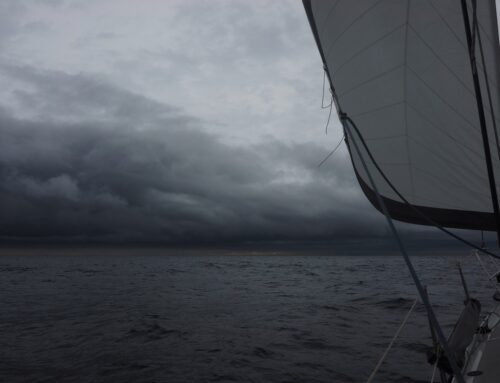
Bart checking out the sea conditions west of Sao Nicolao. Sporty, to say the least.
From Tarrafal we sailed north along the island’s coast before cutting west and, running before a stiff breeze, passed the low cliffs of Ilhéu Raso, home to the famous Raso lark (what? You have never heard of it?! Shame on you), and skirting under the towering ridge of Ilhéu Branco before anchoring in the ‘protection’ of Ilha de Santa Luzia in the Bay of Praia do Palmo a Tostão.

View towards Sao Nicolau.
Another tricky anchorage
That last bit, ‘before anchoring’, sounds so easy but actually it took us six drops before our anchor found sand instead of rock platform. We have never had to try more than twice before and even then, only very, very rarely more than once. Six times left us feeling a bit shame faced, what were we doing wrong?

Looking back to Sao Nicolao. Sailing conditions were indeed sporty, with a maximum of 34kts.
Well as it turned out, we weren’t doing much wrong at all – while some of the rock was black, most of it was covered in a white, crustose algae which from above the water looked for all the world like sand. Anyway, after a lot of bouncing the anchor over white rock we eventually got it settled, albeit somewhat precariously.


Sailing past Ilhéu Raso towards Ilhéu Branco.
When we dived it later it turned out not be set but actually just hooked under a ledge with the chain snaking off in between rocks – serviceable but nothing more.

Yuma passing Ilhéu Branco. Here, we spotted a large pod of Pantropical spotted dolphins, as well as four tropic birds and an osprey.
Despite our dodgy anchor set, we ended up spending a few days at Santa Luzia, snorkelling, birding and enjoying the views.

Approaching Ilha de Santa Luzia.
More garoupa
Perhaps half a kilometre further east along the beach from where we were anchored there was a small group of spearfishers from São Vincente who were camped out in a cluster of huts a bit back from the beach.

View from our anchor spot towards the campsite of the spearfishers, as well as the gap through which the tradewinds would funnel into the anchorage.
They were descendants of earlier inhabitants of the island and as such retained the right to fish its waters commercially. Every month or so they came across with their banana boats loaded up with ice to spent four or five days spearing cod, trout, octopus and lobster for the markets in Mindelo. Each morning they would head out, five or six men to a boat, returning late in the afternoon.

São Vincente spearfishers returning to their camp.
We called one boat over on their return one evening and bought a few garoupa for dinner. They were very keen to load us up with lobster and a free octopus or two, but with three delicious garoupa and limited refrigeration any extra would have all just gone to waste so we declined. Bemused, they waved us good bye and headed off back to their camp.


Buying three garoupas for dinner – they were delicious!
A ‘protected’ anchorage?
This anchorage, like all our previous anchorages on Sal and São Nicolau, was windy with a lot of chop. This seems to be standard fare for Cabo Verde. Here at Santa Luzia, the NE trade winds were funnelled between two mountains making them accelerate as they came out of the gap and straight across the anchorage.

Beautiful view from our anchorage. Bummer about the rolling.
With enough fetch, there was pretty much continuous, and at times uncomfortable rolling. So, after a few days, we started to look forward to a bit of no-rolling time in the marina of Mandelo. Little did we realise how foolish this wish was!