
Crossing to mainland Brazil
Leaving FdN behind
The crossing from Fernando de Noronha (FdN) to Salvador, on Brazil’s east coast, took almost exactly five days. We departed on a warm sunny day with a light wind on our port quarter and ambled along FdN’s north coast, past layered cliffs that dropped down into crystal clear waters.

FdN slowly disappearing from view.
In some sections the shore line was lined with dog-tooth rocks and islets, in others the lining was bright white beaches that are ranked as among Brazil’s most beautiful and which host international surfing competitions but, more frequently, simply provide a substrate for clusters of happy Brazilian families soaking up together time in the sun.


We were not the only ones out there, so we kept a good watch.
The further west along the island we went the smaller the beaches got and the less human activity there was to see, until it was just us, the sea, the rocks and above them scrub and the birds.


Sunrise and sunset on the second day of our crossing to mainland Brazil.
Lots of birds
Of the latter there were many: masked and red-footed boobies gliding low and slow over the water, common noddies on brisk wings flitting down suddenly to pick small somethings from the surface, white-tailed tropicbirds wheeling out across the water in long slow arcs, and magnificent frigate birds soaring slowing and ponderously, almost with an aura of disappointment, perhaps because, at this time of year, they had to do their own hunting.

Conditions are just about perfect.
On FdN’s western end we cleared Ponta da Sapata and, coming out of the lee of the island, were able to put a bit more south into our heading and pick up the fresh ESE breeze of the open water. This had the pleasant effect of putting a bit of a spring into our step and we were soon heading off at 6.5 kts over a gently rolling sea. With warm sunshine, easy seas and a good breeze it was very relaxed sailing; we couldn’t have asked for much more.

The incredibly blue water of the deep ocean.
But no mammals
Well, of course, being sailors, there was something else we could have asked for; whales. Just a mile or so from FdN the ocean floor drops from a few 10s of metres deep to over 1000m deep and then over the next few miles drops another two or three thousand metres – perfect habitat for sea life and particularly marine mammals!


Sunset and full moonrise one hour apart.
Well, that’s the theory at any rate. While the birds didn’t disappoint, the mammals certainly did. Despite the (literally) hundreds of spinner dolphins we’d seen while anchored at FdN, including that very morning, and despite the fact that we kept a careful watch, we didn’t see a single dolphin or whale as we crossed the shelf. Nothing. Oh well.

Full moon on Yuma. Almost bright enough to read a book.
Sailing without dramas
The next five days passed uneventfully; exactly the kind of sailing one wants, no excitement, no dramas. We sailed on a beautifully calm sea with a gradually decreasing wind and under bright tropical sunshine during the day and starry and moonlit skies at night.


Next morning, full moonset and sunrise around the same time.
This happy state was heightened even more by incidents such as common noddies spending the night with us onboard Yuma, a pod of 10-15 pantropical spotted dolphins bow-riding at sunset, and 100s of common terns (plus one masked booby) fishing all around us for hours and hours on end.

A raft of common terns, Sterna hirundo, taking a rest from fishing.
But with some excitement
Clearly it wasn’t really an uneventful crossing and indeed we had two other events that ranked as exciting. The first of these was the capture of a very yummy small tuna which was turned into a very fresh poke bowl and tuna steaks.


David requested fresh tuna for dinner. So Frederieke caught a tuna.
The second was a not so happy incident (but not very serious incident) when a rogue wave came pitching over the side and into the cockpit and in through open hatches into the galley and the aft cabin. A rude awakening for David!


The sunrise was particularly special this morning.
Approaching Salvador
Sailing-wise though, with just a little trimming of the sails and the occasional tweak of the windvane we had a very relaxed time of it until, about 13 hours out of Salvador, by which time the gradually decreasing wind had decreased to the point that it had completely blown itself out and we were essentially just drifting along with the current at one or two knots.

Another little bit of excitement: a common tern catching a ride on our radar.
Happily, by this point we were just 12 nm offshore and so, given the time of the year, the current was at least going in the right direction. With a forecast of no more wind for four days and the flopping of the sails getting a bit annoying, we decided it was time to fire up the iron genoa and motor the last stretch.


Common terns fishing around Yuma.
We had no real expectations of Salvador. We knew it was the old capital of Brazil, the country’s third largest city and home to an impressive Carnaval but beyond that, not much more. This made watching it appear as we came down the coast really interesting.

The Brazilian coastline heralded by a line of ‘land’ clouds.
From the Atlantic coast side, it builds from coastal dunes interspersed with low urban and industrial areas that gradually become denser and quickly morph into an enormous forest of towering and slender skyscraper apartment buildings that crowd along the beaches and the high ridge that runs along the city’s eastern coast. It looked huge.

Salvador in the distance.
To be honest, we should have expected that but it came as a surprise. Perhaps it was the contrast with being alone on the Atlantic, and with Fernando de Noronha and Cabo Verde. Whatever the reason, it took our breath away.


Salvador slowly coming into view.
A berth in Porto Salvador Marina
With sails already furled, we turned west and motored into the entrance of the Baía de Todos-os-Santos. Very quickly the towering apartment blocks began to disappear and were soon replaced by the walls of the Old City, the port facilities and the sprawl of the less glamourous side of the city. Beyond this city centre area stretched what, from a distance, looked like pleasant beachside suburbs. All still impressive, just different to the ocean approach.

The approach to Porto Salvador Marina.
The Porto Salvador Marina is hidden away behind the Forte de São Marcelo and next to the ferry terminal and here, on the outer pontoon we were met by the manager Dominique and a marineirho, ready to take our ropes.
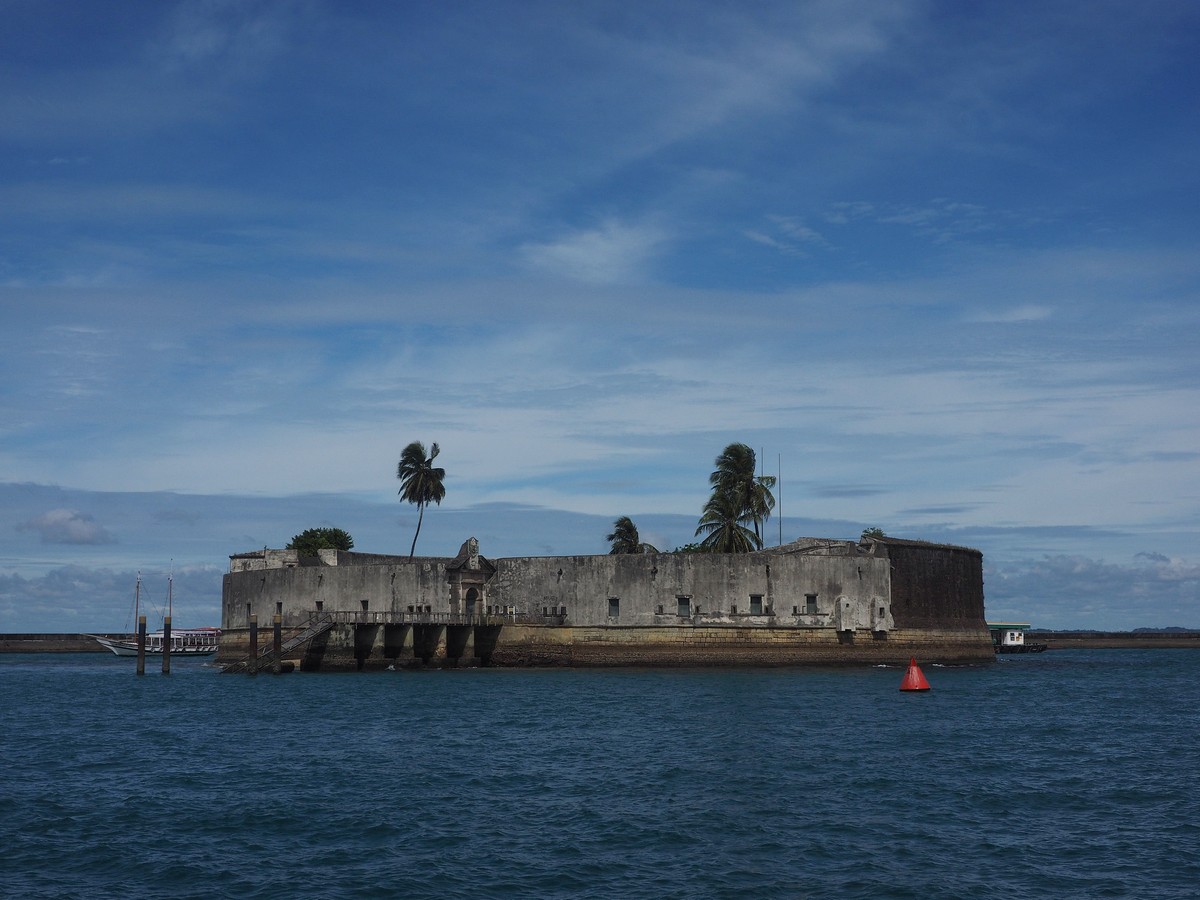
Forte de São Marcelo.
As always happens when there is a welcoming party like this, we (to be specific, David) completely botched the parking manoeuvre. Oh dear. Dominique however was too diplomatic to say anything at all about it and instead simply offered us a warm welcome and told us to get ourselves in order because he would soon be back to help us check in to Brazil.

A Manx Shearwater, Puffinus puffinus.
Brazilian bureaucracy
And, indeed he was. Fifteen minutes later he was hurrying us out into the street and off to the almost all-in-one check in service. Brazil is famous for its tortuous check in processes for cruising yachts (it is by no means alone in this and is certainly not the most difficult). When clearing into or out of the country one has to go through a strict sequence of visits. First, to the Harbour Master and Navy, then the Police, then Customs and then the Harbour Master again. It is a process that can take a couple of days.

Nice fish art in lieu of pictures of the Brazilian bureaucracy.
Importantly, this is a formal affair that requires appropriate clothing: neat shirt with a collar, long pants, shoes and socks for men, neat shirt and skirt for women. No hats allowed. Failure to adhere to these standards will result in refused entry to official buildings.

Sailboat art.
In addition, when traveling between states within Brazil, boats have to clear into and out of each state or major port. This requires that you repeat that process, though this time omitting Customs. Apparently, this too can take a day or two. We had experienced something similar in Cabo Verde, though there it is a very relaxed and friendly affair that took half an hour, assuming the relevant officials could be found.

And another fish art, as one can never get enough of anything to do with fish.
Salvador check-in: 1h 22 min
In Salvador, however, things are apparently different to the rest of Brazil. In Salvador, Dominique takes you to Ramon who manages the Harbour and Navy side of things. Ramon then sends you a couple of hundred metres down the road to the Police and Customs who are conveniently located across the corridor from each other in the same building.
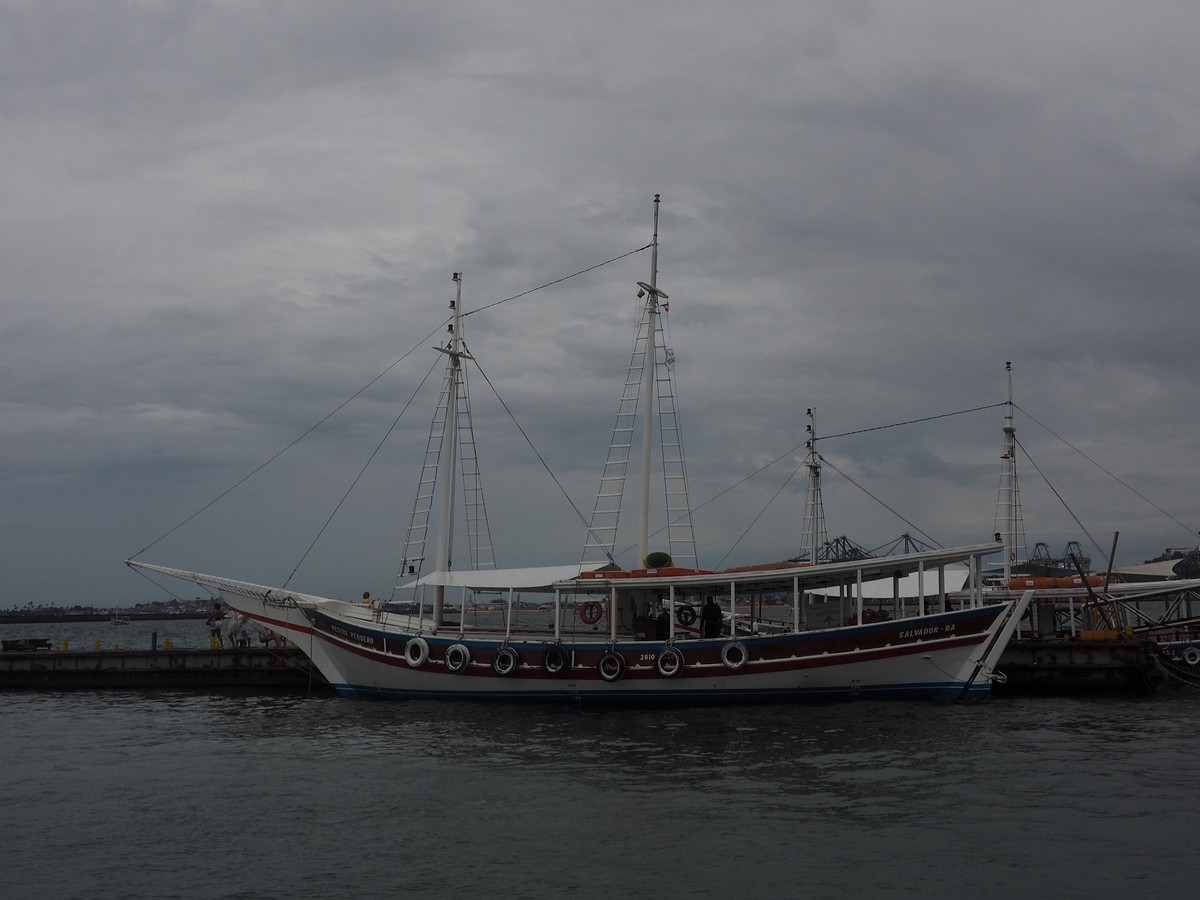
The harbour was full of nice old schooners (escunas) that now serve as tourist boats.
You then go back to Ramon who checks their work, enters it into the Navy database, gives you tourist information and fills out your application for a Brazilian CPF number (equivalent of a Tax File Number or Social Security number), gives you a cup of coffee and sends you back to Dominique.

Another colourful tourist boat.
Dominique then checks all of everybody’s work for errors, provides additional advice on visas and visa extensions, and provides all the travel information one could dream of. Total time for everything up to returning to Dominique – 1 hour and 22 minutes. Superb service!
Once all this was done it was time to relax and recover from our five-day passage, and the completion of our Atlantic crossing.


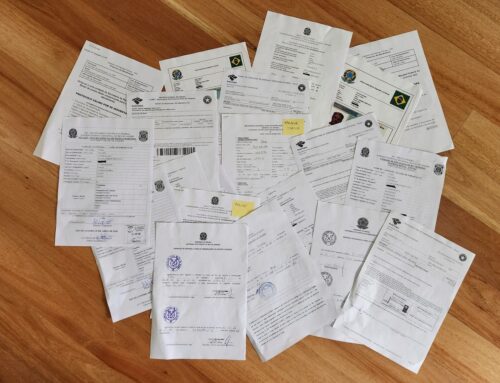
Ook in Brazilië 🇧🇷 dus op en top bureaucratie aanwezig ☺️. Gelukkig goedgekeurd.
Rara, wat is het land waar in- en uitchecken het meest onduidelijk is? Juist, Nederland! Het duurde 4 (!!) dagen voordat we ingeklaard waren in IIJmuiden.
En uitklaren via een email, zoals ons was geadviseerd door één douane ambtenaar, was, bij terugkeer in Nld, niet correct volgens een andere ambtenaar. We hadden onze paspoorten moeten laten stempelen. Tja.
Found you.. beautiful photos! I wondered on the “entry protcols” for sailing into harbours.. bureaucracy abounds everywhere.
I’ll take tuna for dinner as well.
It’s the Easter weekend eve, so I hope this finds you in many celebrations (I’m not religious but enjoy the food indulgences].
I’ll log in again Trace
Hoi Tracy, glad you found us and like the photos.
The bureaucracy varies from none at all to radioing in on the appropriate channel to get permission to enter and then spending a day or more visiting various offices paperwork signing and stamping and vetting. Usually though it is pretty easy and in most places the officials are both very friendly and extremely helpful. That is particularly the case here in Brazil where the official stuff in general has taken almost no time at all while the drinking coffee and chatting has sometimes taken hours. Our first and most difficult entry was into Ijmuiden in the Netherlands. The process there took 4 days and lots of phoning and visiting offices, but again, the officials were friendly and as helpful as they could be.
I hope the Easter indulgence recovery has gone well!
Finally, i have some minutes to read the stories during my parisian breakfast . It’s more interesting than the global news. I especially envy the yummy tuna prepared by David. One day since my Sailing glass works well ! cheers
When will you get a chance to use them on Yuma?