The archipelago of Fernando de Noronha
A bit of history
The official story, based of Amerigo Verspucci’s account at least, is that the first tourists to visit Fernando de Noronha (FdN) were a Portuguese expedition led by Fernão de Loronha who arrived on the 10th of August 1503. Like many of the tourists who visit the island today, the Portuguese stayed for a week before heading off on their way south-west.

Like the Portuguese many centuries ago, we arrived by boat, spent about a week at FdN, and then moved on.
Despite the official date of discovery being 1503, the islands, located 200nm off the northeast coast of Brazil, appear on Juan de la Cosa’s 1500 nautical chart and, on Alberto Cantino’s 1502 Quaresma chart. There are some interesting explanations for this slight discrepancy in dates, but the most mundane, and probably most realistic, possibility is that someone Portuguese had enjoyed these islands’ delights before Señor de Loronha.

View over Baía de Santo Antônio, the main anchoring area on FdN. The small port hosts barges, fishing vessels, and tourist and diving boats.
It was Fernando’s name, however, that stuck to the islands. This wasn’t some vanity move on Fernão’s part, he had actually called them the Ilhas de São Lourenço, reflecting the Saint’s day on which they were sighted, and for a while they were also referred to as the Ilhas São João. Fernando de Noronha, however, was finally settled upon because of his lasting influence on the islands’ development.


Two bird species endemic to FdN: Noronha elaenia, Elaenia ridleyana (left), and Noronha vireo, Vireo gracilirostris (middle, right).
Captaincy over FdN
As part of the establishment of colonial control over Brazil in the 16th century, the Portuguese King established a series of Captaincies over different parts of the coast. These Captaincies functioned as Governorships and gave the Captains control over pretty much all activity in their Captaincy.

Morro Dois Irmãos, or Two Brothers Rocks.
Fernão held the hereditary captaincy of the FdN islands as well as an official monopoly on trade in Brazil and between Brazil and Portugal. Not a bad gig. The FdN islands served as the transport hub in his web of activities and remained the family’s private property until well after the expiration of his lovely trade monopoly.

Cool modern artwork.
A brief Dutch interlude
Life on the island seems to have ticked along quite nicely until 1629 when the Dutch West India Company took possession of FdN as part of their occupation of Brazil’s northeast region. The Dutch were on a bit of a hiding to nothing, though, as the Company’s real focus was the Caribbean and its sugar production, so ultimately the financial and military support necessary to hold onto this newly ‘acquired’ territory wasn’t forthcoming.

The Dutch episode on the FdN timeline in the local museum.
In 1654 the Portuguese managed to kick the Dutch out and the islands (along with various parts of the mainland) became Portuguese once again. And this is how the Brazilians in the NE states avoided becoming Dutch speakers.


The Dutch weren’t the only invaders – two of the many introduced species to FdN. The tegu, Salvator merianae, was meant to control rats but also happily preys on native fauna. The rock cavy or mocó, Kerodon rupestris, served as a food source.
After this brief period of excitement, the islands seem to have settle back into a quiet life until the establishment of a penal colony there in the late 1800s. Indeed, so little happened that the visit by Charles Darwin and the Beagle in 1832 is one of the major historical events portrayed in the island’s museum today. We can only hope that this quiet island life was also a good life.

One of the old churches on FdN.
More recent history
In the 20th C, however, things began to heat up again on the island. First it became an important link in transoceanic communications cable networks before also becoming a refueling stop for early trans-oceanic aviation.

Eared dove, Zenaida auriculata.
Then in 1988 roughly 70% of the islands and their surrounding waters were declared a Marine National Park before being listed as a World Heritage Site in 2001. Combined with perfect beach weather, this naturally led to the islands developing into one of Brazil’s most prized tourist destinations.

The island does beaches very well, and is a popular surfing destination.
Happily, at about the time of the park’s declaration, a limit was set on how many tourists could be on the island at any one time. This was done to protect the parks natural environment and to ensure that visitors did not overwhelm the islands resources (particularly fresh water) and infrastructure.

Parque National signs were everywhere on the island. The Park is managed by the Chico Mendes Institute, named after the man who was murdered for his efforts to preserve the Amazon rainforest.
This limit is still in effect today with a daily cap of 460-500 tourists and means that while tourism is the all-consuming economic focus of the island, it has not consumed all of the island. Most resorts and hotels are small, somewhat rustic and low key in nature, as if perhaps being locally developed and owned. Furthermore, the place has a feel to it of a small town community, which of course is exactly what it is.


Spectacular Red-footed boobies, Sula sula.
The unfortunate side to this for the visitor is that, while by general tourism standards the island is ‘rustic’, this charm is offered at what can best be described as ‘premium’ prices. This, then, is a place that would only be visited by Brazilians with a reasonable amount of spare cash. Luckily for the island, Brazil has a huge middle class and there is clearly no shortage of folk who want to partake of the island’s pleasures.

The sunsets were pretty nice, especially with a flock of Magnificent frigatebirds, Fregata magnificens, surrounding a small fishing boat.
Checking in to Brazil
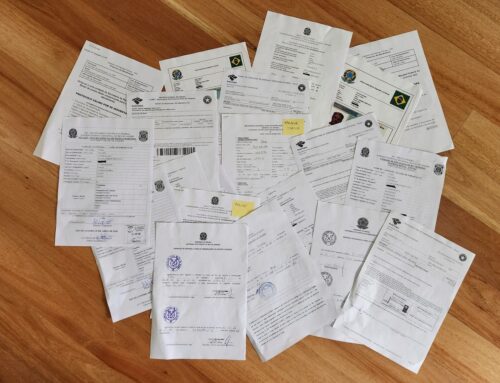
Our first task upon arriving in FdN was to get ashore and get ourselves cleared in. So having tidied up Yuma and ourselves, we got the dinghy in the water and headed across to the Harbour Master’s office. As we climbed up the gangway from the floating dock, we were intercepted by two very friendly Brazilian Navy officers who had been waiting for us and who escorted us down to said office.


Colourful crabs, feeding on the sand, on the rocks and in the leaf litter.
Here, we had a very jolly time of not quite understanding each other and then correcting our misunderstandings and despite it all this, slowly getting the paperwork sorted out. Getting our immigration stamps required sending off our passports with a woman who appeared to have just wandered in off the street but supposedly worked for immigration. We were told that she would bring them back at 1900 and give them to the Harbour Master, if he was still there, otherwise tomorrow, or before we left, we could pick them up. Whatever, they were just passports.

Happy spinner dolphin in the Baía de Santo Antônio.
Dolphin watching
With formalities completed, we could relax into our spectacular surroundings and spend our time enjoying all that the island had to offer. Foremost amongst the different nature-based tourism offerings at FdN are whale and dolphin watching tours with the latter, at this time of the year, being the most reliable performers and easily the favourites.


‘Golfinho-rotador’ is the delightful name for spinner dolphins in Portuguese.
Yuma, being anchored in the centre of the harbour, turned out to be the perfect spot for dolphin watching and so we spent a couple of days doing not much at all other than watching dolphins. Every day 20, 30, 40 or more spinner dolphins spent hours hunting backwards and forwards across the harbour in ever-changing pods of a few to a dozen individuals.

Dolphins would swim by every day. What a treat!
While quartering the seafloor to herd their prey was their focus, there were always one or two individuals whose excitement could not be contained and which suddenly burst clear of the water, leaping high and spinning multiple times before crashing back down.


Another happy rotador dolphin.
They would often do this five or six times in rapid but clearly flagging succession. We tried, mostly unsuccessfully, to get photos of them jumping. Too often they were too far away to make a good photo, or would jump unexpectedly over there, then again somewhere else. It was hard. That at any rate is our excuse for our pretty average shots.

Leap! A very happy spinner dolphin.
Either way, the dolphin watching was fascinating and only enhanced by the fact that the dolphins almost completely ignore the scores of tourists that follow them on pedal boats, kayaks, and in motor boats of various sizes. Unfortunately, but not surprising, you are not allowed to be in the water when the dolphins are around, so there was no snorkeling or diving with them.


And, because dolphins make us happy, a few more photos of a rotador.
Diving
While not allowed to be done with the dolphins, diving and snorkeling are also among FdN’s major attractions. With a generous selection of rocky dive sites, a number of wrecks and abundant sea life that mixes tropical and temperate species, this is hardly surprising.

We did not bring our UW cameras on the dives, as commercial outfits generally swim way too fast for photo taking. So, instead, more above-water photos. Here, Red-footed booby, Sula sula, carrying nesting material.
Of particular interest are the number and variety of shark species that can be seen (if you aren’t David and Frederieke who seem to always be looking at little creatures when the big creatures come swimming along).

Cute little wasp on jasmin-like flower. At least, it smelled like jasmin.
While we have our own dive gear on board, finding a dive location on FdN where one is allowed to dive alone and can easily leave a dinghy, proved to be a bit of a conundrum. So, after checking out a few companies, and recovering from the shock when we learned the price per person (let’s just say more than in Australia), we decided to do two dives with Noronha Diver.

Noronha Diver was located in this colourful building. Again, colours like the Dutch Antilles!
This was a great outfit with a wooden boat that was in dire need of a paint job, but with a captain who could manoeuvre her into the tightest of places and a crew who were as excited to be diving as we were. Luckily, there were only three other tourists on the boat and these were also experienced divers, so we got to do two of the more advanced dives the company had on offer, Cagarras Funda and Ilha do Meio do Cabritos.


Nesting brown noddies, Anous stolidus.
The second one in particular was exhilarating, being dropped off on the island’s exposed site and drift diving through a narrow and shallow (appr 2 m) gap into the protected site. All the while waving to surprised-looking fish as we were flying by! A great dive that we would never have been able to find or do by ourselves.

White-tailed Tropicbird, Phaethon lepturus.
We didn’t see any sharks while diving, though everyone else on the boat did. We made up for it later though when we sat on a cliff, looking down on Sancho beach and watched a very large tiger shark cruising along in between the breakers about 50m away from a mob of happy, plump and completely unaware Brazilians. No sharks were fed and no Brazilians were hurt in this episode.

The rather beautiful Baía do Sancho, where we saw the tiger shark.
Walking
Finally, we spent a bit of time on land hiking various trails on the island and lots of time watching and photographing the island’s beautiful birds. One morning, walking down a muddy road to do a hike, we were lucky enough to be able to observe at close quarters a very modern creature that we had only ever heard of before; an influencer.


Some of the great coastal views during our hikes.
This came in the form of a plump Polish woman who was heading the same way and wanted to make sure she was on the right road. We told her that we hoped she was because that was where we were going too and she immediately launched into a discussion in English.

A beautiful skink.
We quickly found out that she had actually lived in Amsterdam for the past 15 years and so the conversation switched to Dutch and, she being more comfortable in that language, increased her rate of talking dramatically until the sound of her voice, like a stream running over rocks, became a constant babble.


More White-tailed Tropicbirds, Phaethon lepturus.
For the next couple of hours, she stuck to us and kept up an entertaining monologue, pausing only to take selfies, to ask us to take a photo of her, and occasionally to whip out a new piece of clothing to take another selfie.


Noivinha, or Atlantic white tern, Gygis alba. According to a Park’s sign, when a human couple sees a Noivinha couple, the love between the pairs is genuine. Either way, we did see a pair, so we’re all good on that score but for all you singletons out there, be careful who you go birding with.
All up she might have taken a 100 selfies during the couple of hours before we parted company. Every now and again she would offer to take a picture of us and was a bit baffled when we said, ‘yeah, nah, not necessary but thanks’. She was a handful but she was nice and she was fun.


De foto’s zijn wel zo goed gelukt dat ik vrolijk wordt van de aanblik van al die dolfijnen. Een foto van de influencer die op dit prachtige eiland een kledingstuk promoot had mijn nieuwsgierigheid wel wat bevredigend. Aan de andere kant ; seen one, seen them all.
Dankjewel! Ja, je hebt gelijk, een foto vd influencer zou passend zijn geweest. Een gemiste kans! Als ik ooit een foto van haar vind zet ik m er op 😄.
More wonderful adventures! That of course if only natural when you’re travelling the world on a small sailing boat. I’m really enjoying the journey with you.
🙂