The mountainous island of São Nicolau
After a few days, and with the weather having moderated rather improved, we decided that it was time to leave Sal anyway and head further west. With 2+m waves and 20+ kts of wind on our starboard quarter we expected a relatively easy, if sporty, run across the strait to Baía do Carrical on the island of São Nicolau.
And indeed, that was exactly what we got – big, rolling waves, with just enough of a cross-swell to get the boat moving unnecessarily, and strong winds on the port quarter combined to make for a fun passage.

Bart in his element.
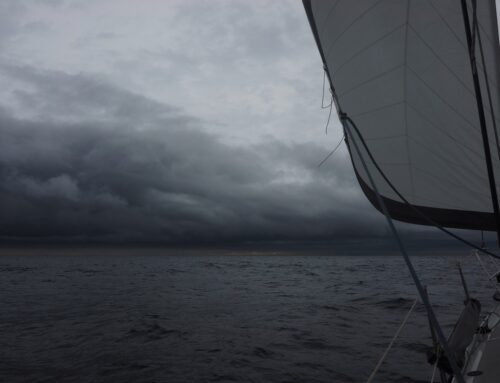
An LPG-procurement delay in the morning meant that we only managed to clear Ponte Leste on Ilha de São Nicolau’s SW corner in the dark and with conditions having got worse rather than better, we were approaching our intended anchorage at Baía do Carriçal in what felt like something more serious than sporty conditions.
Dodgy conditions in a dodgy anchorage
We had almost pitch-black darkness, rain, strong and gusting winds and were entering an unfamiliar anchorage with a narrow band of sand for anchoring, a rocky lee-shore washed by surf just 50m away, and fishing boat moorings, lines and assorted gear in the water. What could possibly go wrong? Lots, of course, but we decided to give it a go, one shot.

Ilha do Sal slowly disappearing over the horizon.
After a bit of preparation, we turned in with Frederieke on the helm, Bart on the bow as spotlight operator, and David on the windlass. Even with the bright light of the spotlight the bay was so dark in the rain that the rocks, just a few metres to port, were all but invisible to us, though the sound of the waves breaking on them was clear and threatening.
Our spotlight, however, got the fish all worked up and there was a constant splashing ahead of us with rushing the surface and leaping clear in bright silver arcs. That, at least, was worth seeing.

A bit of happy fish-art while we’re manoeuvring around in a dodgy bay.
With shouted warnings from Bart about buoys or lines in the water, Frederieke carefully manoeuvred Yuma up into the wind at the one spot where we thought we could safely anchor. The anchor dropped into 8m in one go and I payed out the chain to 3:1 before belaying to test its hold. Instead of a nice soft stop, I felt the metallic rumble of the anchor skipping over rock. No good. With another shout to hold position and inch forward, I retrieved the anchor and we fled back out to deeper water.
We made one more unsuccessful and equally nerve-wracking attempt at anchoring in a similarly dodgy spot further around in the bay before heading back out sea and making for the more protected western side of the island.

Yuma picked up a lot of Saharan dust in Cabo Verde.
Bart took the first watch as we ran under the triple reefed headsail down to the SW. While we were both sound asleep below, Bart, who was on his first solo night watch, got the fright of his life when he heard a loud “Bang!”. Oh no, he thought, what have I hit. To his great relief though he hadn’t steered Yuma into something hard, but rather, a large flying fish had slammed into the dinghy hanging immediately behind the helm station.
A much better anchorage
Four hours later, at 0300, we dropped anchor in the relative calm of Ponta do Papagaio. This time the anchor bit quietly and immediately, and Yuma stopped gently when I belayed. She went nowhere when Frederieke tested the set. Time to sleep!

Our anchorage, with a view to Monte Gordo. Not bad!
When we woke the next morning, we found ourselves in a spectacular location and a slightly confusing situation. Spectacular because of the dramatic high bluffs that ran south along the shoreline and the beautiful rocky shore and low, tussocky headland to the north with its backdrop of the high, cloud enveloped peak of Monte Gordo.

One of the four French yachts that had seemingly come out of nowhere.
Confusing because we found that we were anchored in the midst of a small flotilla of four French yachts, none of which we’d seen as we came in during the night. We never did figure out whether they were there before us and we’d just missed them (that felt unlikely) or whether they had arrived in the morning before we awoke. A delicious mystery.
Ponta do Papagaio proved to be a lovely spot for a few days, with good snorkelling, swimming and beach walking. Bart and Frederieke even managed a bit of fishing. Unsuccessful fishing, mind you.

Bart and Frederieke fishing (unsuccessfully) from Yuma.
A free fish
Our next stop was just an hour of very slow (and unsuccessful) trolling to the north, the port of Tarrafal, squeezed into the narrow gap between the skirts of the cliffs of Monte Gordo and the sea. As we dropped anchor we hailed a fisherman in an open skiff. Given that our fishing had been unsuccessful we were hoping that he was a bit better at it than we were.

The coastline south of Tarrafal
And, indeed, he was. He sized us up, selected a mackerel that he figured would feed the three of us and then, refusing payment, headed off on his way. Much more generous than he needed to be and much more generous than we deserved. Feeling just a tad guilty, we enjoyed a delicious meal!

The approach to Porto do Tarrafal.
Porto do Tarrafal
Tarrafal was established as a minor fishing port but grew to be a whaling resupply port in the 19th century before becoming a tuna canning centre later that century. Much more recently the port has been rejuvenated and become the main commercial port for the island of São Nicolau. As a consequence, the town has expanded and been renewed during the last two or three decades and it is now a colourful and buzzing little place.


Landscapes along the westcoast of São Nicolau.
The anchorage is well protected from the NE trade winds that dominate here, but not at all protected from the strong, and sometimes ferocious, katabatic winds that come whipping down through the canyons on Monto Gordo. This made life onboard a bit uncomfortable at times, and demanded regular checks on Yuma’s, and of neighbouring boats’, position.

Katabatic winds come gusting down into the Tarrafal anchorage through canyons like this one.
At one point a boat had anchored particularly close upwind of Yuma and Frederieke rowed over to ask them to move. They understood the situation and were happy to do so, but while she was rowing back to Yuma and before they had begun to lift their anchor, they began to drag and drifted off past us, anchor and all, into the Atlantic Ocean! Luckily, after a bit of scrabbling around sorting themselves out, they came back in and safely anchored further up the bay.


The Tarrafal beach with very original Xmas decorations.
A steep walk uphill
The day after the anchor dragging incident Frederieke and Bart did a walk up on the foothills of Monte Gordo while David stayed behind on anchor watch (with boats dragging their anchors, and more very strong winds forecast for the day, we didn’t feel comfortable leaving Yuma alone).

Bart contemplating the steep valley ahead of him.
From the stop at the port in Tarrafal, Frederieke and Bart took an aluguer (the local form of public transport) to the island’s capital Ribeira Brava, and after a brief tour of the town’s sights, began their walk up into the valley towards the town of Cachaço.


Colourful and not so colourful houses along the walk, as well as carnaval left-overs from a while ago.
The walk followed an old coble-stone road through hamlets and small-scale farms, surrounded by steep mountain slopes.


Views along the way up the valley.
It was hot, and even though we were overtaken by people in cars, in taxis and on donkeys, we did not hail them down and persevered with our uphill climb. And so, after a few hours we found ourselves at the top of the valley with spectacular views back to Ribeira Brava.


At the top was a chapel of some sorts with a great view back over the valley.
We then did a quick walk into Parque Naturel Monto Gordo to see a few native dragon trees, before heading back to Tarrafal, Yuma, and David, by aluguer.

Nice to see a dragon tree in its native habitat. We had first seen these (for us) strange trees in the botanical garden in Gibraltar.
Another natural wonder of Cabo Verde
From Tarrafal we also wandered out to check out the sandstone rock formations carved by wind and water at Carbeirinho.


This made for a pleasant though strangely underwhelming afternoon.


While this is listed as one of the seven wonders of Cabo Verde, on an island of impressive and dramatic landscapes this tiny little pocket of wind-worn sandstone seemed like a relatively minor feature to get excited about.


Still, it made for a few nice photos and the trip out there provided the opportunity to see the village that inspired Cesária Evora’s classic song Sodade. That, and the landscapes along the way, were worth the ride out.


Not a place to fall in the water.
A festival in Tarrafal
Our last afternoon and evening in Tarrafal coincided with a festival on the main square. We had become aware of this festival by the fact that there were no eggs available in town – sold out to make special ‘festival’ cake.


Winnowing and roasting casava flower.
We watched cassava flour being roasted, ate some great barbequed chicken and listened to a band of constantly changing musicians play some fun music before wandering off back to the boat. A fine evening!




Wat een enerverende tijd met Bart. Leuk om hem weer aan boord te zien en op excursie met F.
Was weer erg leuk om Bart weer aan boord te hebben, hij past er goed bij 😍.
Ik was blij dat de vliegende vis in de dinghy was gesprongen ipv tegen mij aan. Het was namelijk een vliegende vis van ca 50cm aan solid muscles. wat een raket . en met de nieuwe maan was het echt rouwdonker.
Sao Nicolau is een prachtig eiland met langs de rivier in de vallei vruchtbare gronden met agroforstry waar ze van alles verbouwen. Een wat dat betreft belangrijk eiland voor de Kaapverden .
Mooi gewandeld langs die vallei met mijn kleuterschool vriendje 😄.