
Big swell in the marina
Back in Salvador
After about a week cruising around in Baía de Todos-os-Santos, we returned to Porto Salvador Marina in Salvador to do some laundry and provisioning, before heading off south along the Bahía coast and the Abrolhos Islands. We ended up once again being Mediterranean moored (stern to the pontoon) next to Christina II, the beautiful classic sloop from La Rochelle.
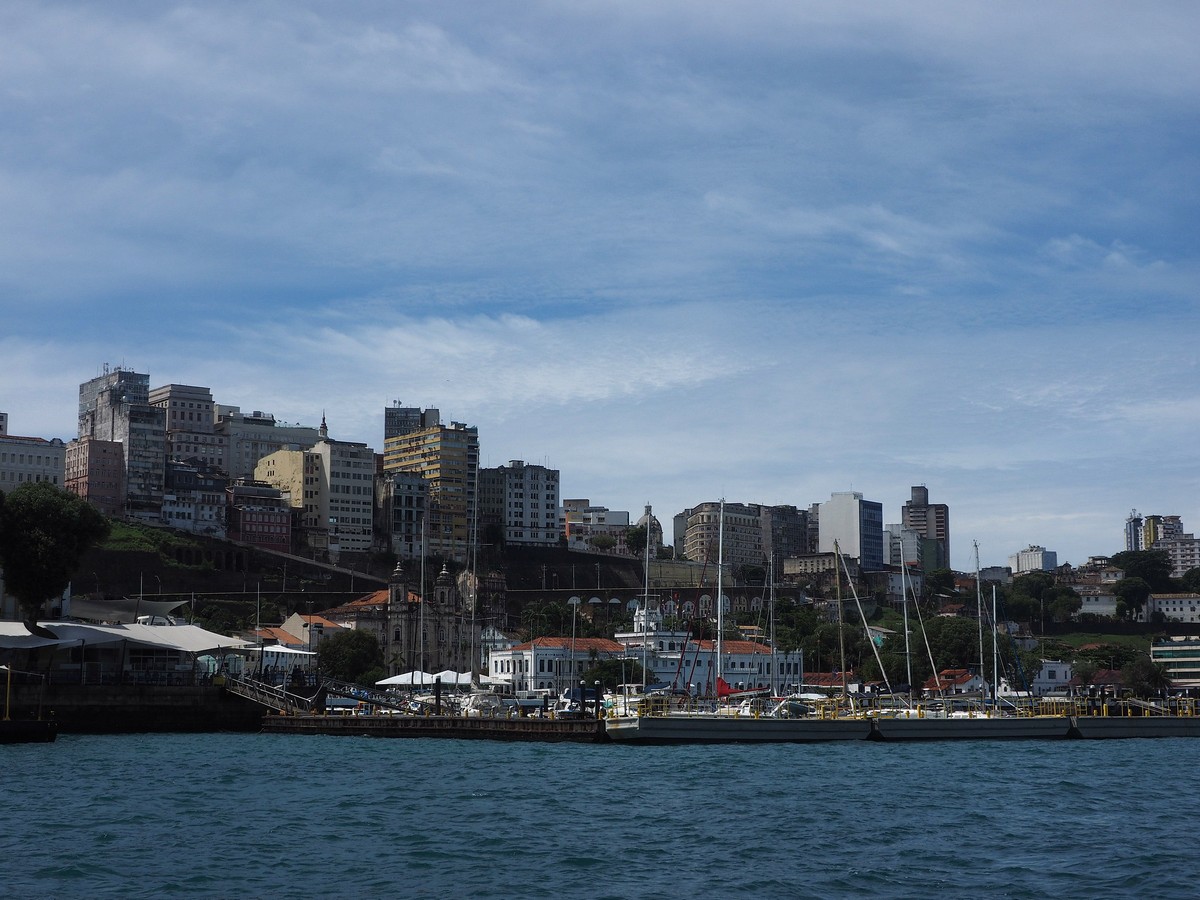
Returning to the Porto Salvador Marina in Salvador.
A bit windy and wavy
Unexpectedly, our stay here lasted a day longer than planned due to a weather event that had not been forecasted. Overnight, the wind had picked up to 20-25kn from the NW and blew straight into the access channel of the marina. Without anything to stop the swell building up over the bay’s 10nm of fetch, Yuma started bucking, rolling and straining against her fore and aft mooring lines.

Another, calmer night at the marina, looking towards the city.
Not being a good sleeper at the best of time when the boat is rolling, Frederieke went outside to check on the conditions and found Yuma’s stern bouncing perilously close to the pontoon. Luckily, she managed to tighten the bow lines a bit to keep Yuma from the moving pontoon, while confirming that the masts and standing riggings from Yuma and Christina II were still well separated. After a while, things seemed to have calmed down enough to go back down and crawl back into bed.

Basílica e Santuário Nossa Senhora da Conceição da Praia, built in the 16th-century for sailors and tradesmen, and now overlooking the marina.
Getting ready to leave
Early the next morning, the wind and swell were still low and we prepared to depart. Except that, just as we were preparing to leave, the wind suddenly picked up again from the NW and the swell began to build again, rolling straight into the marina. With Christina II’s skipper, Luis, and one of the marina staff, we tried to get everything ready to make a clean exit but with the wind hard on the beam there was little chance of clearing Christina II.

The beautiful Christina II from La Rochelle, in calmer waters in Salvador. She was built in Vlissingen, The Netherlands, in 1966.
We tried securing warps further up the pontoon to move us away from her in order to get clear but it quickly became apparent that this was not going to work either. In the end we all agreed that it was too late, we would have to wait until conditions subsided, which the ‘fore’cast now suggested would be about 1200.
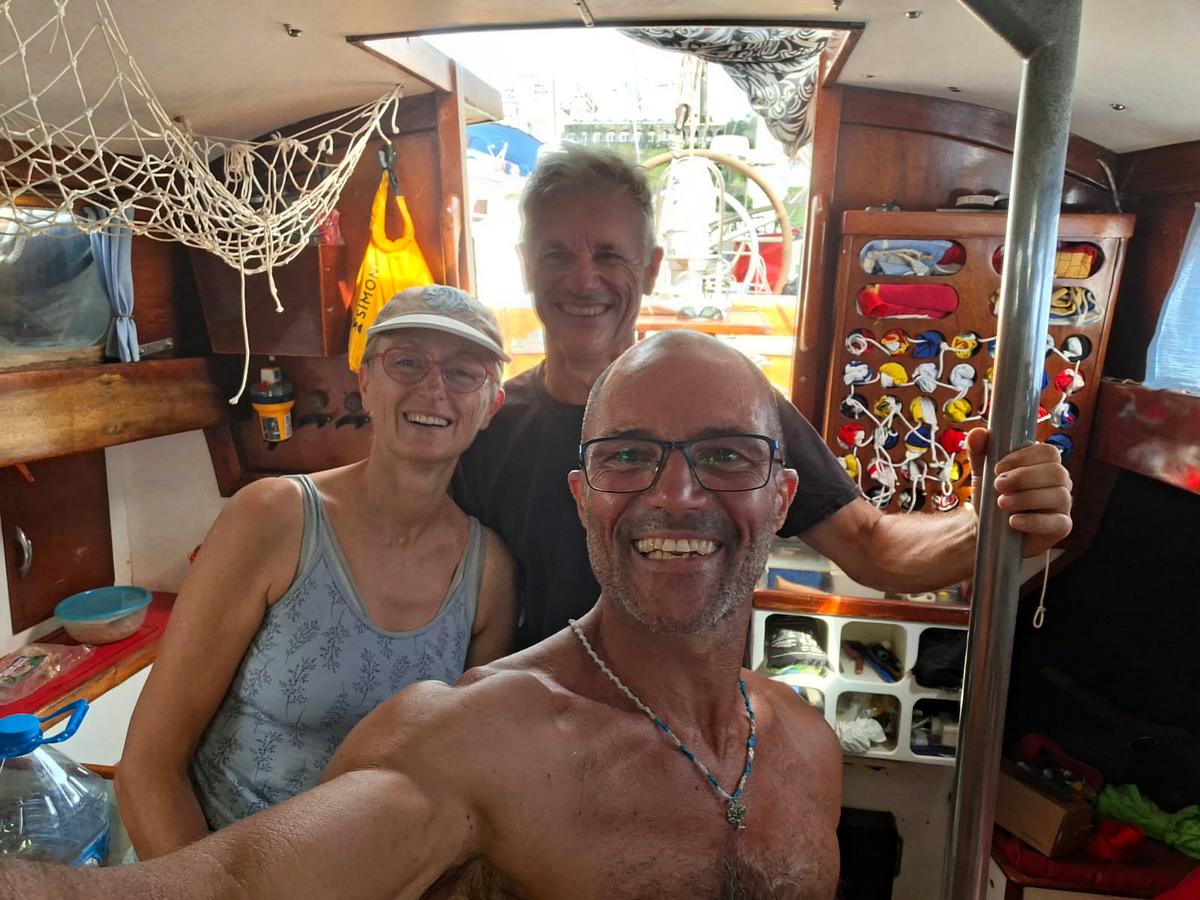
We had visited Luis, and admired Christina II, during our previous stay in Salvador.
Very windy and wavy
This manoeuvring of Yuma up the pontoon and one berth away from Christina II proved to be an absolute godsend. Rather than calming down, the wind picked up considerably and the swell in the marina was increasing even more. Yuma being the windward boat was pulling hard on her lines and was being pushed harder sideways than Christina II which was in Yuma’s lee. Had we not managed (and we only just managed to do so) to move further away the two boats would have been pounding against each other.
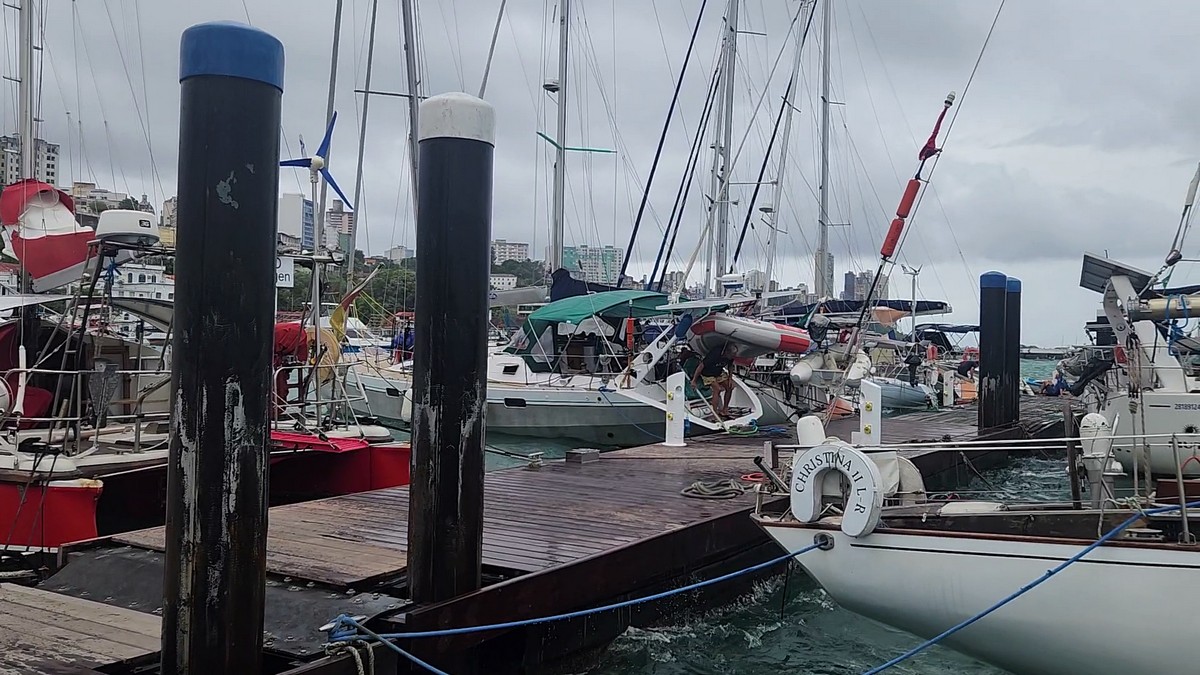
Pontoons and boats being tossed around in the wind and swell. Check the uneven positions of the masts. Taken from Yuma.
Very quickly, we went from light winds to 25kt from the NW and breaking waves in the bay in perhaps 20 minutes; all the boats in the marina were being tossed around like rag dolls. This was only amplified by the fact that the floating pontoons too were heaving on the swell, pulling and pushing on the moored boats as they moved. The conditions were now severe and in fact so bad that the entire Port of Salvador had been closed completely.

These floating pontoons dampened the incoming swell to some extent. Their position also prevented us from tossing our lines and leaving the marina.
Yuma and Christina II, and a few other boats were moored on new pontoons, which, luckily for us, were a lot stronger and moved a lot less than the older ones.
Still, with the wind and waves pushing us back towards the pontoon, one of Yuma’s handholds on the sugar scoop got dented when the stern got caught under a wildly bounding pontoon – we turned on the motor and, accelerating hard managed to moved her far enough out from the pontoon and re-secure the bow lines to prevent a re-occurrence.
The beautiful Christina II also sustained damage when part of her newly restored, stern toe-rail got ripped off as she dropped but the pontoon rose. Poor Luis was philosophical about this damage but nevertheless, it was very sad!

More boats being thrown around – see the boat behind Christina II, being tossed over on her port side. Also taken from Yuma.
Broken pontoons
While we had sustained some damage, further down, on the older pontoons, the scenes were much more dramatic. There, the older timbers were not standing up to the pounding against the pylons as the waves tossed them up and down and backwards and forwards.
Add to this the weight of a big catamaran and a 50+ foot aluminium mono both dancing away on their lines and the pontoons were slowly breaking and splintering apart, boats still attached.
Crew from all boats helped each other as much as they could, but in the end the situation on the older pontoons got dangerous and people were forced to retreat to the newer pontoons or their own boats while there was still some hope of keeping them safe.
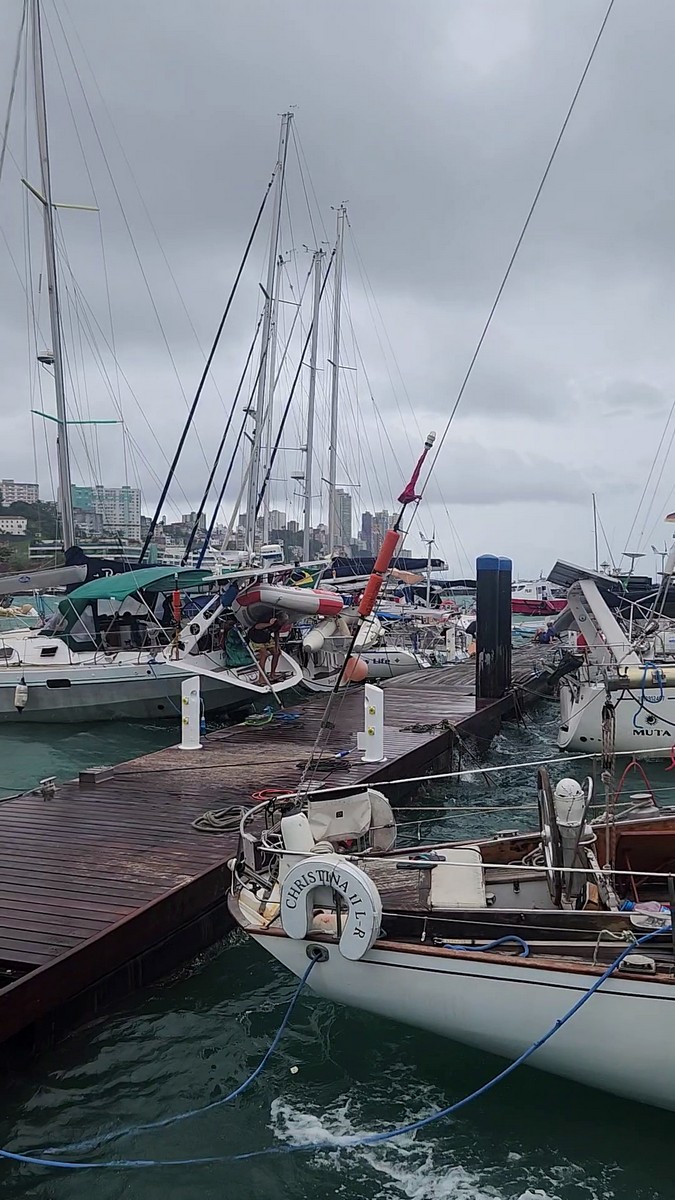
Right in the middle of it – boats being thrown around like rag dolls.
Boats on the leeward side of the pontoon were in a position to drop their lines and leave and gradually they all did so, though some required assistance from a nearby fishing boat to drag their bows through the sharp turn into the wind.
Eventually, as the pontoons broke free and disintegrated even the boats on the windward side of the older pontoons were convinced that they had to cut their lines and do their best to get out of the marina. But by then, most of the damage to the pontoons had been done.
By some miracle, none of the boats (or crew) had sustained critical damage, indeed perhaps Yuma and Christina II suffered the most damage. Arguably, the boats moored on the end of the pontoon should have left much earlier, they resisted efforts to convince them to leave earlier, but hindsight is always a good thing; this event was not forecast and then lasted a lot longer than predicted.

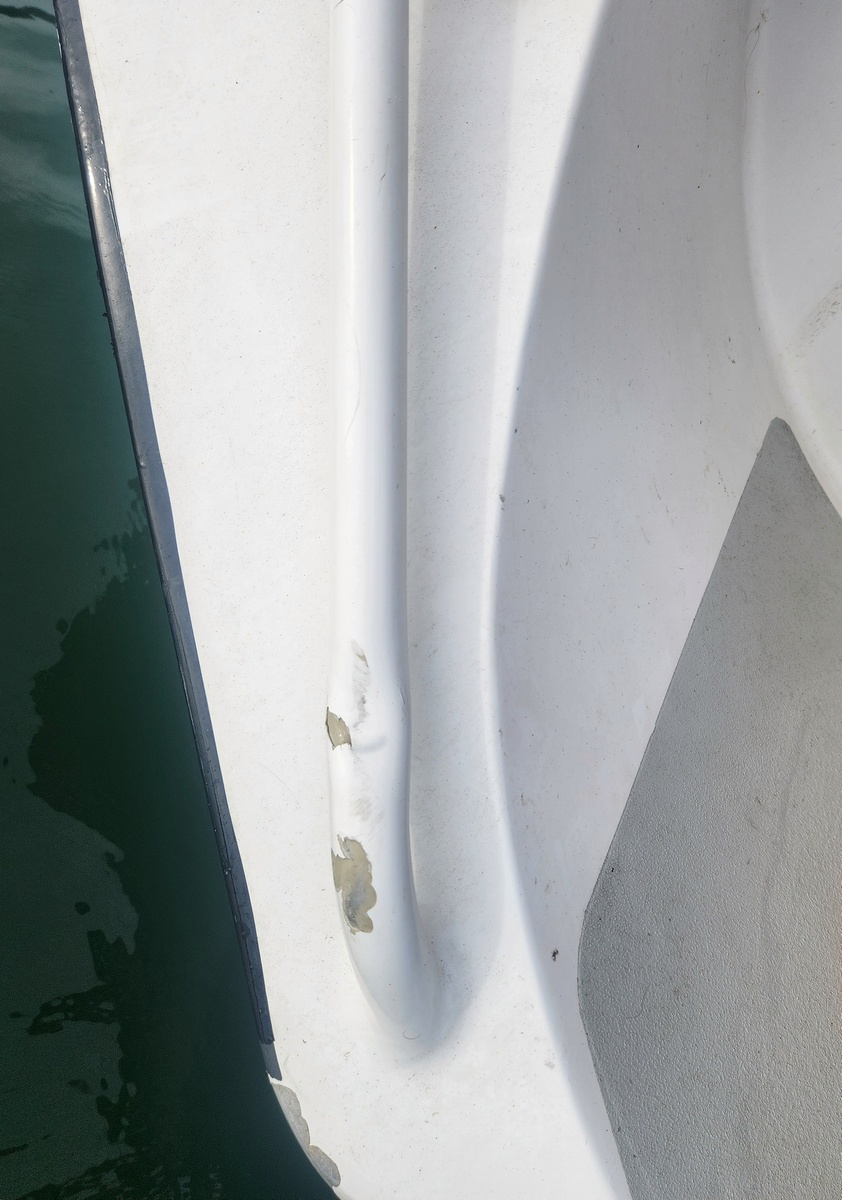
The dent on Yuma’s handhold on the sugar scoop. It doesn’t look like much, but imagine the force necessary to put a dent in this bit of metal. Luckily no feet or hands got caught in between…!
Things calm down
It was only by 1600 that the wind and swell dropped, leaving a scene of devastation scene; one pontoon lost, one totally destroyed, and most of the boats departed. Only the three new pontoons remained (almost) intact.
After surveying Yuma and checking in on the remaining boats, we stayed another night before we departed the next morning for the central coast of Bahía.

A much calmer evening in the marina, a week earlier.
Barentsburg and Salvador
The event very much reminded us of our night in Barentsburg (see our blog ‘A small taste of Russia‘), when we were moored alongside SY Snowbear on the inside of a floating pontoon, when the wind and swell picked up from across the fjord and breaking waves rolled straight into the port.
Here as well, we were flopping around like rag dolls, while tied to SY Snowbear, unable to leave given the tight space in which we were moored and with the pontoon heaving in all directions in the waves, swinging frightening close to rocks and sounding as it if was about to break and roll onto the rocks with the boats attached. One of the scarier nights we’ve had on Yuma.

SY Yuma tied off alongside SY Snowbear, on the inside of the floating dock in Barentsburg. This seemed like a good idea, until the wind picked up and breaking waves smashed into the port and pontoon.
In Salvador, we were lucky that we had been moored up to a new pontoon, and that we had not any boats directly next to us. Being moored on the inside of the marina with the way the swell was running, however, meant that if we had broken loose, we would not have been able to get out and likely ended up pushed into the pontoon and onto other boats. A scary thought, but luckily we got through it relatively unscathed, yet again.
Harbours might seem secure but they can be scary places and sometimes the better option is to take your chances at sea if you can.


Yikes. What’s point of even calling it a marina ???
DK, you’d be surprised at how many marinas (including very respectable marinas) are exposed to potentially damaging wind and waves from one or more directions. And, some times it seems that it simply isn’t possible to make it completely safe. On El Hierro, in the Canary Islands, the marina in the port there is protected on the weather side by a 20m high sea wall and in the tight port entrance side by a narrow, slalom entry channel and yet in a minor storm there we were still rocking and rolling around, in a big storm coming from the other direction it would be very unpleasant. In Cairns they don’t muck around, if a big one is coming, they order you out of the marina and into the mangroves. The marina in Salvador was a fantastic spot, friendly, helpful, and wonderfully located, we’d go back.
Heftig! Gelukkig geen schade die het varen verhindert of persoonlijk letsel
Was idd nogal heftig, maar wwe hebben het er heel vanaf gebracht. En Yuma ook, op n deuk na.