
The lush coast of Bahía
Costa do Dendê
South of Salvador, squeezed between the low uplands that rise 10 or 20 km to the west and the sea in the east, is an area of low-lying undulating country.

Salvador with some greenery. After a couple of weeks in the city, we were keen to see some more forest.
Here old dunes sport scrubby forest cover, cleared grassy pastures remarkably devoid of livestock, and sprawling dusty small-holder farming communities. Here too, big slow rivers have braided themselves into extensive and complex estuaries as they slowly worked their winding paths out to the sea.


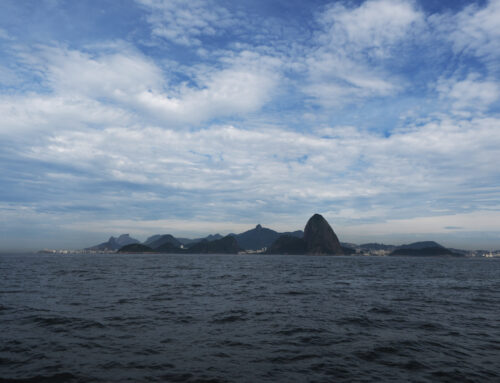
Slowly leaving Salvador astern under dramatic skies.
This is an area with lots of mangroves, lots of islands and lots of twisting, dark-watered creeks that run seawards and back with the tide, exposing muddy, crab-clicking land at low tide and waters, that though moving through tangled mangrove thickets, on the flood seem asleep.


More dramatic skies, this time at our anchorage in the Canal de Itaparica.
This area is called the Costa do Dendê, named after the abundance of the oil palm (Elaeis oleifera) along the coastline. Together with the Costa do Cacau further south, it’s ocean beaches and surf also make it a very popular Brazilian holiday destination. After our exciting last day in Salvador, we wanted to explore a few more of these tropical rivers before crossing to the Abrolhos islands and then heading further south.

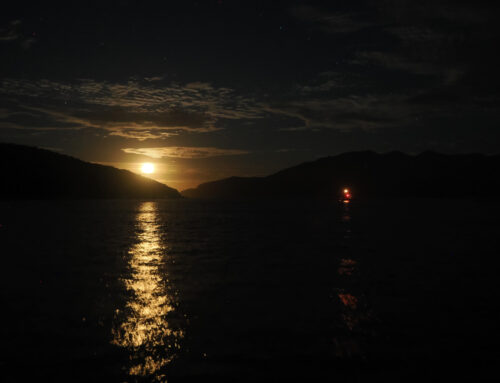
Sunset over Canal de Itaparica.
Tricky river entrances
With shifting sandbanks and strong tidal currents at their entrances, the rivers in this area require thoughtful navigation. Most of these river entrances are quite shallow, meaning that not all sailboats can enter them, some only on certain tides, and all only when conditions are appropriate.


All rivers had colourful tourist boats.
With Yuma’s shallow draft (80 cm) we were free of some of these constraints however and were able to get into and explore a few of them with relative ease.

The skies often looked like we’d get serious thunderstorms, but luckily, we never did.
Recent rainstorms had caused local flooding, resulting in a lot of debris coming down the rivers and being discharged into the ocean. However, unlike the Wet Tropics where such debris may include complete houses, old growth trees, dead cows, old fridges and cars, here it was (luckily for us) mostly large floating islands of water hyacinth (Pontederia crassipes).

Water hyacinth (Pontederia crassipes) was everywhere after local flooding. In the rivers, on the beaches and out on the ocean. Thick and solid enough to be a navigation hazard.

Fish traps were common along the rivers’ edges. Unlit, so best not to manoeuvre around in the dark.
Friendly Brazilians
We went ashore in a couple of small towns along the way, including Gamboa, Campinho and Maraú, in order to stretch our legs, watch some birds and grab a meal. Invariably we were met by the friendliest of people keen to have a chat with two foreigners sailing through their country.


Rainstorm drifting over Morro de São Paolo, at our anchorage off Gamboa.
There were the two ladies at the dock kiosk in Maraú who greeted us like we were faithful regulars each night that we ate there and moaned with us about the loud music that got played there each night.

Gorgeous evening in Maraú on the Rio da Serra, with the dock kiosk in the bottom right and Yuma in the middle. A very pleasant spot to end the day with a meal and a drink.
At Camphino, the riverbank restaurant manager sat with us in a blizzard of mosquitoes to talk about life on the island and her search for the perfect place to live.

All rivers also had jetskies, in this case a swarm of 22. One can only imagine how busy it must be in high season.
Arguably though the best were two brothers (Arthur and Thiago) who ran a tiny kiosk on the beach in Gamboa.

High tide in Gamboa – the water seems to be perilously close to the houses.
Coffee and marmosets
We had been searching for a coffee one morning and had walked through the whole town but with no success; we could find bars selling cervejas and caipirinhas, no problem, but for us it was a bit too early for either.


We found cute fish art, but no coffee…
Their kiosk was the last one on the beach and they didn’t sell coffee either, but without hesitation they pulled out a thermos flask of sweet coffee that they had brought to get themselves through the day and poured out cup after cup for us.

Arthur, David and Thiago in front of the brothers’ kiosk in Gamboa. We compared Brazilian and Australian fruits, and most, if not all we recognised from home.
When asked why they didn’t sell coffee their response was simple, ‘We don’t get many people like you’. And so, over a few coffees, we spent a lovely time in their (and Google Translate’s) company comparing life in Brazil and Australia.

Refreshed after a special coffee-break with Arthur and Thiago, and ready to tackle our walk.
Re-invigorated after the coffee and our time with these super-friendly brothers, we then walked to Morro de São Paolo through a bit of forest, where we saw our first Black-tufted marmosets (Callithrix penicillata)!

We took the ferry ‘San Juan’ from Morro de São Paolo back to Gamboa.
Rio da Serra
We were particularly keen to explore the Rio da Serra, upstream and south of Campinho, as on satellite images this river appeared to be surrounded by extensive areas of Atlantic Forest which we thought would make for good walking and birding.


Slowly moving upstream on the Rio da Serra. The river becomes narrower, the water turns murkier, and the Atlantic Forest is getting closer.

Is it a log? No, it is a snake, a Boa constrictor, crossing the river as we sailed past.
However, similar to the forest around Baia de Todos-os-Santos, access proved to be remarkably difficult, because much of it appears to be privately owned or occupied or it was just physically hard to get into.


Lots of forest, but difficult to get in to.
Nevertheless, we managed to do a few ‘walks’ (or better, bush-bashings) in low scrubby dune forest and scored a few lifers (that is, new bird species for us) along the way.


Pretty butterflies in the Atlantic scrub.
An added bonus of this river was that we managed to find a quiet and beautiful anchorage without noise and music! We promptly stayed for a few extra days just to enjoy this Brazilian rarity.

Sunset at our quiet Brazilian anchorage.
Costa do Cacau
From Costa do Dendê we sailed further south to Costa do Cacau (Cacao coast) and the town of Itacaré.

Sailing down the Rio da Serra back to the river mouth at Campinho, to prepare for our next hop south to Itacaré.
Even though the name of the coast had changed, to our foreign eyes, it looked equally gorgeous with paradisiacal beaches, islands, forest and mangroves.

Due to all the rain and associated run-off, the Rio de Contas had turned a cocoa-colour. Probably not exactly what Costa do Cacau refers to.
The entry into Rio de Contas to the anchorage at Itacaré is a particularly tricky one, being very narrow and shallow with shifting sandbanks and strong tidal currents.


Views of Itacaré along the riverbank.
While we had studied and timed our entry carefully, it was still a bit of a relief when a local dinghy came out to guide us safely through the entrance, into the river and to an anchorage in the bend opposite the town. Here we were welcomed by a few Tucuxi dolphins!

Our anchorage in Rio de Contas at Itacaré.
A lovely town
Itacaré proved to be a delightful surf and beach town, with a friendly vibe and good coffees and ice creams; a place which had a Byron Bay (coastal town in Australia) vibe going. The big difference between the two places?


The waterfront at Itacaré.
The birds on the beaches and in the parks: black vultures (Coragyps atratus) in Itacaré versus bin chickens (i.e. Australian white ibis, Threskiornis molucca) and silver gulls (Chroicocephalus novaehollandiae) in Australia.

A nice close view of a Black vulture.
It would have been an easy place to stay for much longer, were it not for a good weather window to sail out to, and to stay at, the offshore Abrolhos islands. Such weather windows are not so common at this time of the year, so after only two nights we left Itacaré and its beautiful surroundings behind and pointed Yuma south.


Wat een mooie trip. Ook speciaal zo zelf met een boot de rivier op en af te varen.
En zonder krokodillen 🐊, zoals bij ons in de rivieren 😄! Erg relaxing 😎.